Contact us via WhatsApp

Digital Product

Get your product moving again

Connect your product's priorities with business results. We work with your team and leaders to improve decisions about what to build, how the team works and how it is built.
See how we work
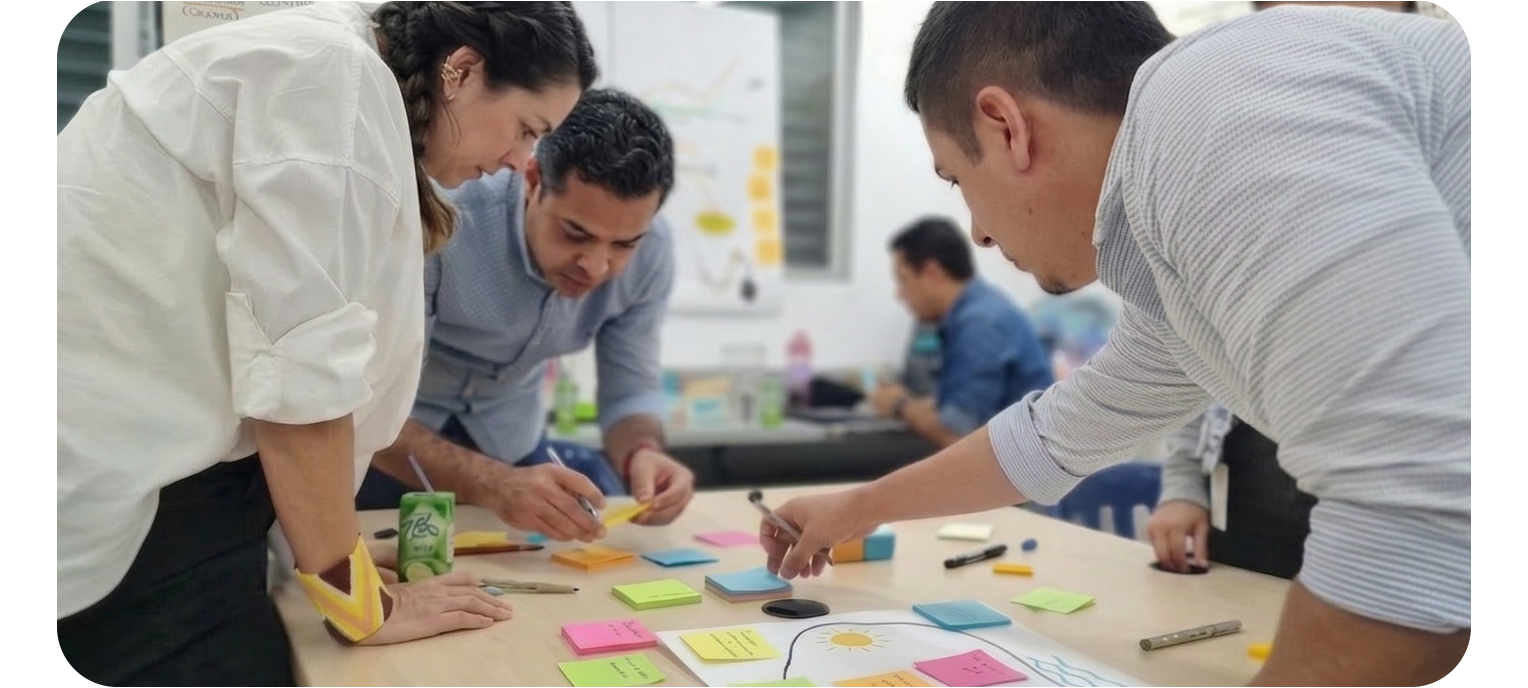
  • We work inside the teams, on your real product

2 weeksof diagnosis to understand the context and what to prioritize.

There is a lot to improve. Let's prioritize where to start.

Your team delivers features, but the product does not reach the results you expect. The challenges can be in priorities, in coordination, or in the difficulty of changing the software.
  • What to build and why: features ship, but the business metrics do not move.
  • How the team works: everyone is putting out fires and rework eats the time.
  • How it is built: every change to the product is expensive, and nobody wants to touch the legacy code.

Three fronts to drive results

Front 01

What to build and why

“We changed the strategy and the new features still answer to the old one.”

  • Priorities tied to the business
  • Decisions backed by user evidence
  • A backlog explained by opportunities, not requests
  • Initiatives measured by their result
Front 02

How the team works

“I end up buried in the detail, sorting out conflicts between teams that cannot coordinate.”

  • Working agreements and focus
  • A visible flow, with no half-done work
  • A trio that decides together
  • Teams that coordinate without escalating every conflict
  • Improvement that carries on once we are gone
Front 03

How it is built

“A one-line change takes us two weeks, and nobody dares touch that module.”

  • AI agents in daily development
  • Engineering practices reviewed with judgment
  • Modernization of existing systems
  • Quality and security that keep up with speed

Recommended approach

From diagnosis to autonomy

We look at product decisions, team coordination and engineering practices together.

  • 1

    Diagnosis

    In two weeks, an initial diagnosis that lets us agree on where to start and how to measure improvement.

  • 2

    Ongoing work and adjustment

    We work on one or several fronts at once and adjust according to the results.

  • 3

    Capability building

    Agreements, guides and habits the team sustains on its own.

What it includes

Duration
3 to 6 months, with a review every 4 weeks.
Effort
Defined during the diagnosis, according to the size of the team and how many teams we include.
With whom
The trio (product management, design and technology) and the people who build; their leaders too.
Format
Work in the daily operation, group sessions and 1:1s. Online or at the client's offices.
What stays
Working agreements, an initiatives board, documented practices, the metrics up and running, and a team that sustains them on its own.

How we measure it

During the diagnosis we define with you what to measure, and we follow it at every review. The goal is for the team to adopt these metrics and keep measuring them once we are gone. We work with two kinds:

Practice metrics, which anticipate the result. They show the capability of the team and the organization, and they move before the business does. For example, inspired by the DORA metrics:
  • Time from the moment something is decided until it reaches users.
  • How often you deliver to production.
  • Share of changes that cause an incident or rework.
  • Time to recover when something fails.

Business metrics, which confirm the result. Every initiative states which result it aims to move, and it gets verified. For example:
  • The indicator the initiative promises to move: conversion, retention, operating cost, response time.
  • Share of initiatives that reach the expected result.

Who it is for

  • Large and mid-sized companies with their own product teams that feel the product stopped moving at the pace of the business.
  • Technology areas moving from projects to products that need business and technology to decide together.
  • Software companies whose product has become hard to change.
  • One team or many: from a five-person team to a product area with several teams, such as a tribe with its squads or cells.

Frequently asked questions

Yes, and several at once too. During the diagnosis we agree on where to start: sometimes it is one front, and often a combination, because a single problem usually has causes in more than one.

It is common that, as work moves forward, new priorities show up in another front. At Technisys, for example, we started with how the product area's teams worked. Once they were delivering every three weeks, the brake became the product installation: several days per release, with lots of manual tasks. We automated it together with the teams, and it went down to hours.

At the review every four weeks we decide together whether to add another front or keep going deeper on the current one.
It is a way of organizing the work in two tracks that move at the same time: one explores what is worth building (talks to users and tests ideas with cheap experiments) and the other delivers what has already been validated.

They are not two teams. They are the same people from business, product management, design and technology, deciding together what moves from one track to the other.

What it is for: so the team learns without stopping deliveries. And it is what ties the three fronts together: what is discovered about what to build reaches how the team works and how it is built, with no handoffs or handover documents.

If you want to know more: the Product Discovery guide (in Spanish).
It depends on the size, and it is defined during the diagnosis.

We always work with a fixed core: the trio (product management, design and technology) and their leaders, because that is where the decisions everyone else follows are made.

With a team of five or ten people, we work with everyone. With fifty, we pick one or two teams to work with directly, and the trio carries what was learned to the rest.

On your side, we ask for weekly time from the trio and their leaders. In large organizations that time is greater, because they are the ones who multiply the change.
They are four indicators that came out of years of research on software development teams (the DevOps Research and Assessment program):
· Lead time: how long a change takes to reach production.
· Frequency: how often you deliver.
· Failure rate: what share of changes causes a problem.
· Recovery: how long it takes to get back to normal when something fails.

What they are for: they anticipate. Research links them to better organizational performance, so they show whether the team is doing well before it shows in the business.

How we use them: as a starting point, adapted to each product. Not every team needs all four, and sometimes it is better to measure something closer to its reality.
It is work on your real product, with the team, in its daily operation. Training is built in, and it changes with the moment the organization is in:
· At the start, when there is no agreement yet on what to change: a short workshop with leaders, to build a common language and decide where to begin.
· With the first teams, learning happens on the job: short capsules on a topic right when the team needs it, and immediate practice on its own backlog, code or agreements.
· When a whole team needs to go deeper on a topic, we add an in-company training. Each front has its own, and you will find them on its page.

The same goes for adopting AI as for adopting new ways of working: what helps at the beginning is not what helps once there are experienced teams.

If you want to know more: Corporate training: kickoff and pilots (in Spanish).
No. We do not take the role of whoever manages the product or leads the technical side, and we do not add people to build.

We work with the people in those roles, on their real work, so they carry on by themselves once we are gone.
Largely, yes. Deciding what to build and organizing how the team works does not depend on the product being software. Before Digital Product we did this under the name Innovation Team, also on physical products and processes.

The path is the same: opportunities, solutions and implementation. What changes are the prototypes: plant trials, models or 3D printing instead of software. For example, with a team at a consumer goods company that brought together production, quality, marketing, logistics and product. We have implemented industrial changes in under four months.

The front about how it is built, on the other hand, is specific to software.

If you want to know more: Corporate training: kickoff and pilots (in Spanish), which tells how that team got started.
Yes. We work with the stack, the tools and the processes the team already uses.

If part of the work is bringing in AI agents, we choose the tools together according to the company's security policies and the kind of data it handles.

What our clients say

Alejandro Raiczyk
Product Lead · Technisys
"From day one I told them this was not going to be a typical case: we could not stop to learn Scrum and then figure out how to apply it. It had to happen on the go, and they understood that. They helped us without stopping the wheel, which had to keep turning."
Contact

Let's start by understanding your case

A 45-minute conversation with the person who will work with your team. You leave with a first reading of what to prioritize, whether you hire us or not.