 Contact us via WhatsApp
Bring this course to your company!
Get In-Company QuoteWhat still holds up in Scrum and how we work with it today, with the whole team and in its real context.
If you came looking for the Certified Scrum Master (CSM) course, it is because for years we taught it at Kleer and many people got certified with us.
Today we no longer offer open certification courses for individuals. We still think Scrum is a valuable framework, so we tell you what still holds up, what we add to it and where we apply it.
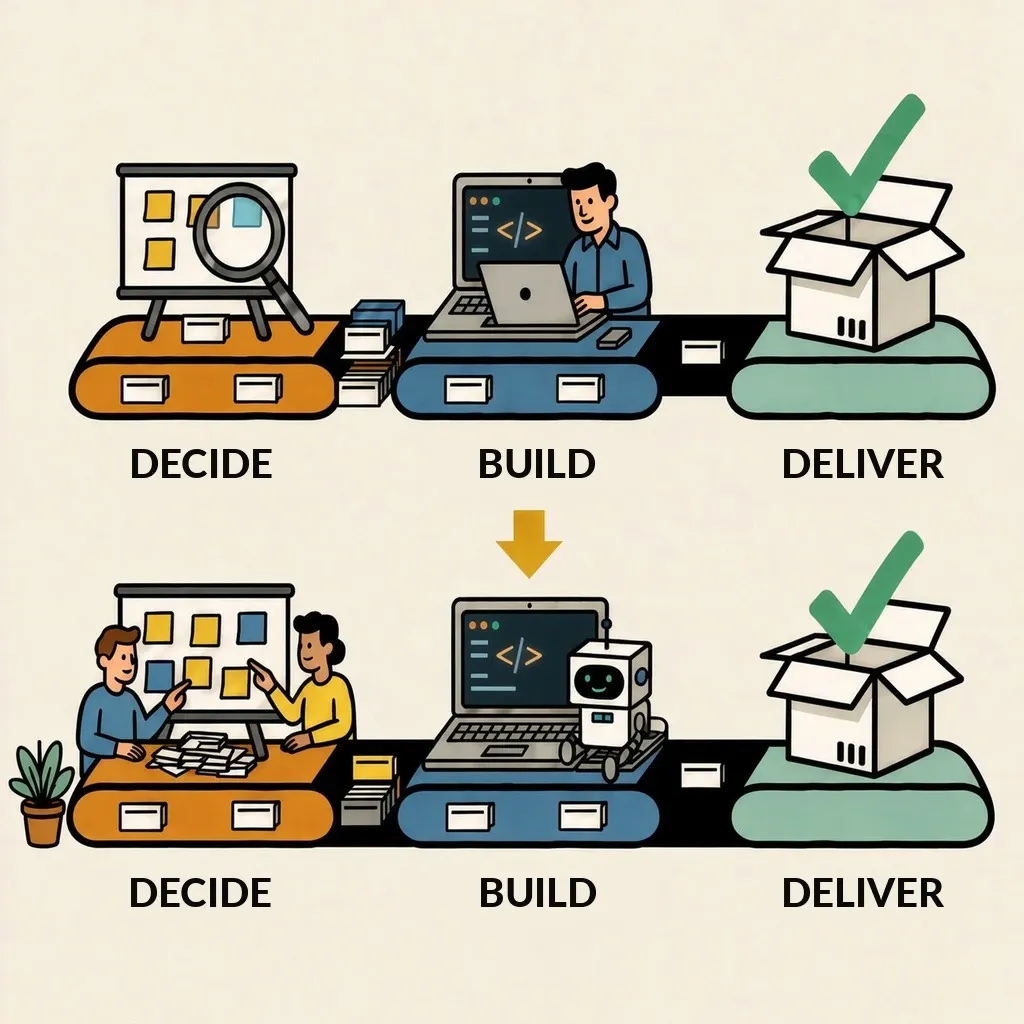
Certifying one person as a Scrum Master has a direct impact only on that person, and an indirect one on their team. Transforming a team requires working with the whole team, in its real context. That is why, instead of individual certification, we work with whole teams.
We understand that Scrum answered the needs of the late 90s, a time when the limit on creating value was the capacity to build software. When something limits the whole, the theory of constraints says that everything else is subordinated to it. Scrum does exactly that:
With AI, building is much faster, and the bottleneck is no longer there. It is in deciding what to build, in validating that it works and in sustaining the quality and security of what is built. The same moves still hold, but applied to the new constraint:
We develop this in the article El cuello de botella cambió de lugar (in Spanish).
We work with whole teams, and with their stakeholders if needed, so that Scrum works in their real context, with their own challenges. See Teams Agility.
In Digital Product we start from where your constraint is today:
An example, in software: Sushi Pop PY loaded its orders from delivery platforms manually or semi-manually, about 25,000 per month. After four weeks every order was registered as soon as it came in, and the first thing eliminated was the risk of losing one. Product mapping, synchronization and the second platform came later, as increments on that base. Today 95% is processed automatically. It is a Kleer Lab case: see the case (in Spanish).
Scrum was born for software, but the logic of the constraint works wherever there is complex work, with a result that is discovered while doing it. An example, outside software: with a consumer goods company we worked with innovation teams that brought together production, quality, marketing, logistics and product. The teams started to plan, review and hold retrospectives in short cycles, with experiments, and the industrial changes arrived in less than four months. We tell it in De la estructura al impacto: un caso de innovación organizacional (in Spanish).

Yes.
We remain convinced of the value of Scrum as a framework and we teach it actively, but to whole teams inside their organizations, not as individual certification in open courses.
If you want to know more: Teams Agility.
It is a framework for developing products in short cycles, with few rules and a lot of feedback.
Our reading: it organizes work around what limits what an organization delivers, which historically was building.
It helps you adapt quickly to a changing context, instead of executing a plan that has gone stale.
If you want to know more: The Scrum Guide.
It is a way to improve a system that starts from a simple idea: in every system something limits what it produces, and improving anything else does not change the result.
It helps you decide where to put the effort, in five steps:
Scrum applies that logic to building software, and with AI the constraint has moved.
If you want to know more: El cuello de botella cambió de lugar (in Spanish).
They protect the constraint: they make sure the people who build can work without interruptions and without waiting.
In practice they do four things:
For that they use facilitation, coaching and mentoring.
With AI they add something more: they help see when the constraint has moved from building to deciding or to validating.
The cycles do not change, but where the constraint is does.
Building gets faster, so the bottleneck moves to deciding what to build and to defining what done means, with quality and security included.
It works when the work is complex and the result is discovered while doing it: a service product, an internal process or an organizational initiative.
What is kept is the logic of short cycles, visible results and learning in every loop.
We applied it with innovation teams at a consumer goods company, with planning, retrospectives and experiments: we tell it here (in Spanish).
Yes.
It is a Scrum Alliance certification, not a Kleer one, and other accredited Certified Scrum Trainers still teach it.
You can check the list of current providers and certifications at Scrum Alliance.
The CSM certifies one person in the Scrum Master role, with an exam and a credential.
Our team work does not certify individuals: it trains your whole team to adopt Scrum in its own context, in a practical way and applied from day one.
Yes.
Having one certified person helps, but it does not by itself solve how the rest of the team lives Scrum day to day.
Working with the whole team covers exactly that part: real adoption, as a team.